Solutions for Franchisees
The FDD you signed isn’t the FDD you’ll renew under.
Your franchisor refiles every year, and the terms drift while you operate — fees, territory language, technology charges, renewal obligations. Clearly reads your signing-year filing against the current one and shows every section that moved, cited to both documents.
One unit, a multi-unit operation, or a portfolio across brands — read what your systems file.
Renewal Comparison
Renew on today’s terms — knowingly.
Your signing-year FDD against the current filing, section by section: what changed, when it changed, and where it says so in each document.
Year-over-Year · Your brand
Read each new filing like an owner.
Every refiling moves something — fee schedules, Item 19 methods, obligations. The Year-over-Year comparison catches it the season it happens, not at renewal.
Multi-unit · Multi-brand
Operating like a platform? Read like one.
Portfolio owners get the same toolkit investors and franchisors use — every brand’s filings in one library, category screens, and custom reports across systems.
Worked example · Renewal Comparison
Eleven years of drift, in one read.
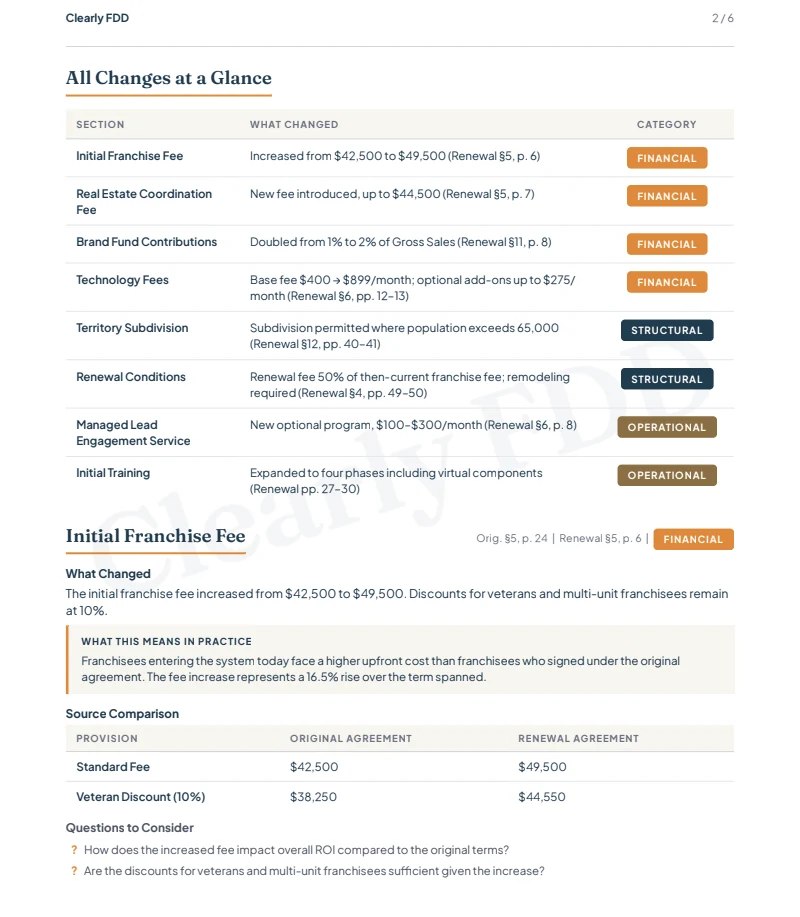
What a Renewal Comparison surfaces. This one read an owner’s 2015 agreement against the brand’s 2026 filing — the document their renewal would reference. Eight of the sections it flagged, as the report summarises them:
| Section | What changed | Category |
|---|---|---|
| Initial franchise fee | Increased from $42,500 to $49,500Renewal §5, p. 6 | Financial |
| Real estate coordination fee | New fee introduced, up to $44,500Renewal §5, p. 7 | Financial |
| Brand fund contributions | Doubled from 1% to 2% of gross salesRenewal §11, p. 8 | Financial |
| Technology fees | Base fee $400 → $899 / month; optional add-ons up to $275 / monthRenewal §6, pp. 12–13 | Financial |
| Territory subdivision | Subdivision permitted where population exceeds 65,000Renewal §12, pp. 40–41 | Structural |
| Renewal conditions | Renewal fee 50% of then-current franchise fee; remodeling requiredRenewal §4, pp. 49–50 | Structural |
| Managed lead engagement service | New optional program, $100–$300 / monthRenewal §6, p. 8 | Operational |
| Initial training | Expanded to four phases including virtual componentsRenewal pp. 27–30 | Operational |
§ An excerpt from a Renewal Comparison delivered to a client, published with their agreement and without naming them: real figures, reproduced as the report states them. The report itself runs longer than these rows — it carries every change it finds out in longhand, cited to both the original and the renewal agreement. We report what changed; what it means for your renewal is a conversation for you and your advisers.
Moments in the process
You operate the system. Read what it files.
“My renewal is 18 months out. What am I actually walking into?”
The Renewal Comparison reads your signing-year FDD against the current filing — every fee, obligation, and territory term that moved, with page references on both.
OutcomeYou and your attorney prepare from documented change, not memory.
“A new line item showed up on my statement. Was that ever disclosed?”
Open your brand’s Workspace and ask Clara where the current filing discloses the charge — Item 6, Item 8, or nowhere — with the citation to check.
OutcomeStatement line items traced to the disclosure, or flagged as absent from it.
“I’m opening unit four — and the agreement on the table isn’t the one I signed.”
Expansion is a new signing under the current FDD. Read today’s Item 6, 7, and 12 against your existing agreements before you commit the capital.
OutcomeUnit four priced on 2026 terms, not 2019 memory.
“I run three brands. Filing season is three 400-page documents.”
Every brand you operate, in one library — each new filing diffed against the last, section by section, the season it lands.
OutcomeA portfolio filing-season sweep in an afternoon.
“We’re adding a fourth brand to the platform. Which one?”
Multi-brand operators get the investor toolkit: category screens across every filed system — units, growth, investment, Item 19 disclosure — plus full Workspace diligence on the shortlist.
OutcomeThe next brand chosen on disclosure, not on the best sales pitch.
“Our franchisee association wants everyone reading from the same page.”
Renewal Comparisons for long-term changes, plus the Year-over-Year comparison included in each current Workspace when available — so every owner sees the same documented changes before the group meets.
OutcomeAssociation conversations grounded in shared source documents.
Eleven years in the system deserves a current read of it.
We report what changed in the filings — what it means for your business is yours to decide, with your advisers.