Solutions for Attorneys
Your hours belong on the clauses that matter.
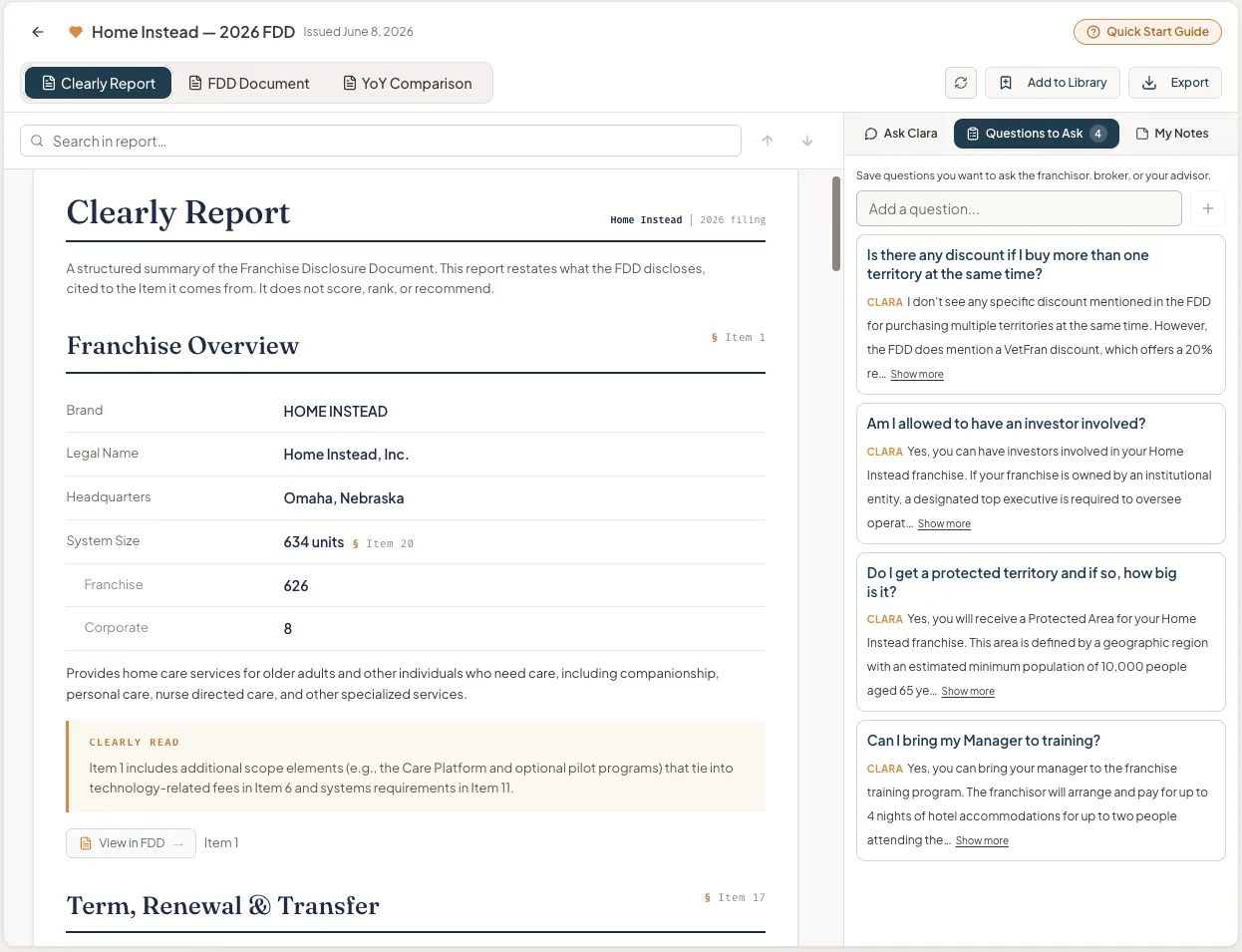
A client who has worked through their FDD in a Clearly Workspace arrives with organized, cited questions. A client who pasted it into a generic chatbot arrives with a version of the brand that may not exist. Clearly makes sure you get the first one.
You advise on what it means. The FDD stays the source. Clearly connects the two.
They asked a chatbot first
The untangling problem, solved upstream.
Generic LLMs blend other brands and last year’s numbers into confident answers. Clara answers only from the FDD open in that Workspace, cited to the Item and page — so you correct clauses, not misconceptions.
Citations you can verify
Checking the work takes seconds.
Every answer points to the Item and page it came from. When a client says “Clearly said the territory is protected,” you open the filing to the cited line and read the actual language.
No legal advice, ever
We say what it says. You say what it means.
Clearly explains disclosure and consistently directs clients to counsel for interpretation. It complements the engagement instead of competing with it.
Across engagements
When the client is choosing between brands.
Clearly Comparison puts the disclosed terms side by side, so the engagement starts from comparable facts rather than three separate 400-page readings.
| Field | Jersey Mike's | Firehouse Subs | Jimmy John's |
|---|---|---|---|
| Initial investment | $436K–$1.2M | $405K–$1.6M | $366K–$734K |
| Royalty | 6.5% | 6% | 6% |
| System size | 3,227 units | 1,291 units | 2,777 units |
| Item 19 | Disclosed | Disclosed | Disclosed |
Moments in the engagement
The questions get specific. So do the answers.
“My client already ‘knows’ things about the brand — from a chatbot.”
Send them to the brand’s Clearly Workspace. Clara answers only from that filing, cited — the chatbot version gets replaced by the disclosed version before it reaches your desk.
OutcomeBillable hours go to counsel, not to untangling.
“The client just received the FDD and wants to ‘go over all of it.’”
They work the Clearly Report first — fees, investment, territory, obligations, all cited. The engagement narrows to the clauses that are unusual and the questions specific to their situation.
OutcomeA scoped review instead of a guided tour.
“I need the exact language, not a summary.”
Every cited answer links back into the filing itself. Open the Item, read the clause, copy the language — for this brand or any brand in the library.
OutcomeVerification in seconds, quotation with confidence.
“A franchisee client is coming up on renewal.”
Year-over-Year surfaces every section that moved between filings — fees, Item 19, territory language, renewal terms — ordered by how much changed.
OutcomeYou counsel on what changed, without re-reading both filings.
“How unusual is this clause, really?”
Pull the same Item across comparable brands in the category and see how the market discloses it — royalty structures, territory protection, required purchases, transfer terms.
Outcome“This is standard” or “this is worth negotiating,” grounded in filings.
“The client keeps asking business questions on legal time.”
Unit counts, investment ranges, Item 19 math — Clearly answers the what-does-it-say questions so your time stays on what-does-it-mean-for-you.
OutcomeThe engagement stays legal; the client still gets answers.
Not only during review
Part of the practice toolkit.
Prepared clients. Verifiable citations. Hours where they belong.
Clearly explains what the document says. You advise on what it means.