Clearly FDD / Resources / What Is Item 20 in an FDD? Why It Matters More Than Most Buyers Realize
FDD Deep Dive · Updated
What Is Item 20 in an FDD? Why It Matters More Than Most Buyers Realize
Quick answer
Item 20 is the section of the Franchise Disclosure Document that shows how the franchise system has changed over time. It includes information about outlet openings, closures, transfers, and the number of franchised and company-owned locations, along with a list of current and former franchisees.
Key takeaways
- Item 20 helps you evaluate the size, growth, and stability of a franchise system
- It can reveal patterns in openings, closures, transfers, and franchisee turnover
- The list of current and former franchisees can be valuable for validation calls
- Strong growth is not always a positive sign, and closures are not the only red flag
- Item 20 should be reviewed alongside Item 19, Item 21, and your broader due diligence
Questions to ask
- Is this franchise system growing in a healthy and sustainable way?
- Are closures, transfers, or terminations pointing to deeper issues?
- What can current and former franchisees tell me that the FDD alone cannot?
What Is Item 20?
Item 20 is one of the most useful sections in the FDD because it shows what has been happening across the franchise system over time.
While some parts of the FDD focus on legal obligations, fees, or the franchisor's background, Item 20 gives you a broader view of the system itself. It can help you understand how many units are open, whether the system is expanding or shrinking, and how much movement there has been among franchisees.
It is also the section that provides contact information for current franchisees, and in many cases former franchisees, which makes it especially important for anyone doing serious validation work.
What information does Item 20 include?
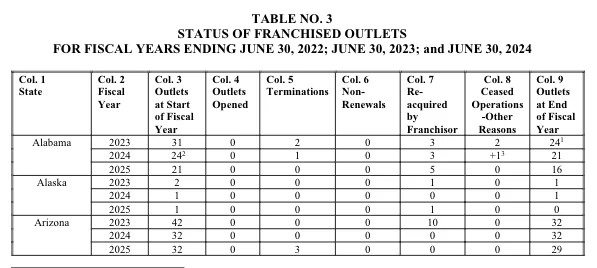
Item 20 typically includes several tables showing changes in the system over the past three years. These may include:
- The number of franchised outlets at the beginning and end of each year
- The number of company-owned outlets at the beginning and end of each year
- The number of new outlets opened
- The number of outlets transferred to new owners
- The number of outlets terminated, canceled, non-renewed, or otherwise closed
- A list of current franchisees
- A list of former franchisees, depending on the circumstances and disclosure requirements
Taken together, these disclosures can offer useful insight into system momentum, franchisee turnover, and overall stability.
Why does Item 20 matter?
A franchise system can sound compelling in a sales conversation while telling a more complicated story in the FDD.
Item 20 helps you move beyond the pitch by showing what has actually been happening in the system. A franchise may be growing quickly, but that does not always mean the opportunity is strong. On the other hand, a system with limited growth is not necessarily weak. What matters is the pattern.
For example, if the system is adding new locations while also experiencing a high number of transfers or closures, that may deserve a closer look. If franchisees appear to be leaving after only a short time, that is worth understanding. If company-owned locations are expanding while franchised outlets are struggling, that can raise a different set of questions.
Item 20 will not give you every answer, but it can help you identify where the deeper questions are.
What should you look for in Item 20?
1. Overall system growth
Start by looking at whether the total number of outlets is increasing, staying flat, or declining.
Growth can be a positive sign, but it should be viewed in context. Fast expansion can put pressure on training, support, and consistency. Slower growth may be perfectly healthy if the system is stable and operators are performing well.
2. Closures and terminations
Closures are one of the first things many buyers look for, and for good reason. If a meaningful number of locations have closed, been terminated, or not renewed, you should try to understand why.
A few closures may not be unusual. A pattern of closures is more significant.
3. Transfers
Transfers are often overlooked, but they can be very important. A transfer means the outlet changed hands. That can happen for many reasons, some routine and some concerning.
A high number of transfers may suggest franchisees are exiting sooner than expected, struggling with performance, or deciding the business is not the right fit.
4. Company-owned vs. franchised outlets
Compare the trends in company-owned and franchised locations. If the franchisor is opening or holding more company-owned locations while franchisees are closing or transferring out, that may be worth understanding more deeply.
5. Franchisee lists
The list of current and former franchisees is one of the most practical parts of Item 20. It gives you names and contact information that can help you conduct validation calls and hear directly from people in the system.
This is where research becomes much more real.
What it tells you
It can help you understand how many units are open, whether the system is expanding or shrinking, and how much movement there has been among franchisees.
What it doesn't
It does not explain every reason behind a closure, transfer, or termination. It does not tell you whether a location was profitable.
What to ask next — and who to ask
The list of current and former franchisees gives you names and contact information that can help you conduct validation calls and hear directly from people in the system.
What does Item 20 not tell you?
As useful as Item 20 can be, it still has limits.
It does not explain every reason behind a closure, transfer, or termination. It does not tell you whether a location was profitable. It does not capture the full story of the relationship between the franchisor and franchisees. And it does not replace speaking directly with current and former operators.
That is why Item 20 should be treated as a starting point for better questions, not as a final conclusion.
How does Item 20 work with other parts of the FDD?
Item 20 is even more useful when you review it alongside other sections of the FDD.
- Item 19 may help you understand reported financial performance, if the franchisor provides it
- Item 21 gives you the franchisor's financial statements
- Item 12 explains territory rights and limitations
- Item 7 outlines the estimated initial investment
Looking at these sections together can give you a more complete picture of both the opportunity and the risk.
What questions should you ask after reading Item 20?
After reviewing Item 20, consider asking:
- Why have locations been transferred or closed in recent years?
- Are there particular markets with stronger or weaker performance?
- How long do franchisees typically stay in the system?
- What should I understand about the former franchisees listed here?
- Are there patterns I should ask current franchisees about during validation?
These kinds of questions can help turn Item 20 from a table of numbers into something much more useful.
What's the bottom line on Item 20?
Item 20 may not get as much attention as Item 19, but it can be one of the most revealing parts of the FDD.
It helps you understand how a franchise system has changed over time, where there may be signs of strength or instability, and who you may want to speak with before moving forward.
If you are seriously evaluating a franchise, Item 20 deserves a close look.
Frequently Asked Questions
Is Item 20 required in every FDD?
Yes. Unlike Item 19, Item 20 is a mandatory disclosure. Every franchisor must include information about outlets and franchisee lists.
How many years of data does Item 20 cover?
Item 20 typically covers three fiscal years of outlet data, showing openings, closures, transfers, and terminations.
What is the difference between a closure and a transfer in Item 20?
A closure means the outlet stopped operating. A transfer means ownership changed hands — the outlet may still be open under a new franchisee.
Should I contact former franchisees listed in Item 20?
Yes. Former franchisees can offer valuable perspective on why they left the system and what challenges they faced.
“Why have locations been transferred or closed in recent years?”
Reading Item 20 in a specific FDD?
Work through it with Guided Review
Guided Review walks through the outlet tables with you and explains what changed across the years. It helps you separate openings, closures, terminations, and transfers, with citations to the table and page in the filing. It also points you to questions to verify with current and former franchisees.
Explore franchise disclosure data in the directory:
§ Based on the FTC Franchise Rule (16 CFR Part 436) Item 20 requirements. This article explains how the disclosure works; it is not legal or financial advice, and it does not evaluate any franchise offering.