Clearly FDD / Resources / Franchise Territory Explained: What Item 12 Really Means in an FDD
FDD Deep Dive · Updated
Franchise Territory Explained: What Item 12 Really Means in an FDD
Quick answer
Item 12 of the Franchise Disclosure Document explains whether you will receive a protected territory and what limits, exceptions, or competitive risks may still apply. It is an important section because territory can affect your customer base, growth potential, and long-term value as a franchisee.
Key takeaways
- A franchise territory is not always exclusive, even if it sounds protected
- Item 12 explains where you can operate and where the franchisor may still compete
- Restrictions on online sales, national accounts, alternative channels, or nontraditional locations can matter more than buyers expect
- Territory terms should be reviewed carefully alongside the Franchise Agreement
- A "protected territory" can still come with important carve-outs and limitations
Questions to ask
- Do I actually have meaningful protection in this territory?
- In what ways can the franchisor still compete with me?
- How could online sales, alternative channels, or future expansion affect my business?
What Is Item 12?
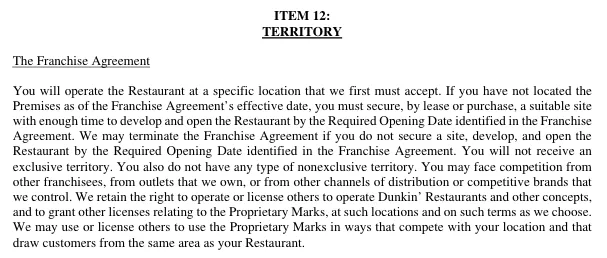
Item 12 is the section of the FDD that explains your territory rights, if any, as a franchisee.
For many prospective franchisees, territory sounds simple: where your business is located and the area around it. In reality, it can be much more nuanced. Some franchise systems offer exclusive territories, some offer limited protection, and some offer no protected territory at all.
Item 12 is where the franchisor explains whether you will have a designated area, what protections come with it, and what exceptions may allow the franchisor or others to compete within or around that territory.
Why does Item 12 matter?
Territory can have a direct impact on the economics and long-term stability of your business.
If your territory is too small, too loosely protected, or subject to broad exceptions, your market opportunity may be more limited than you expected. If the franchisor can continue selling through other channels, place other operators nearby, or serve customers in your area through different means, the protection may be narrower than it first appears.
This is one of the reasons Item 12 deserves more attention than many buyers give it. Territory is not just about geography. It is about market rights, competitive boundaries, and what kind of runway you truly have.
What information does Item 12 usually include?
Item 12 typically addresses several important points, including:
- Whether you will receive a protected or exclusive territory
- How that territory is defined
- Whether the franchisor can operate company-owned units nearby
- Whether other franchisees or channels can serve customers in your area
- Whether online sales, national accounts, kiosks, airports, stadiums, grocery stores, or other nontraditional locations are excluded from your protection
- Whether your territory can change over time based on population, development, or performance conditions
These details matter because the headline — "yes, you get a territory" — often does not tell the full story.
What should you look for in Item 12?
1. Is the territory actually exclusive?
Start by determining whether the FDD says the territory is exclusive, protected, limited, or non-exclusive.
Those are not interchangeable terms.
Some franchisors grant a defined territory with real protection against additional franchised units nearby. Others reserve broad rights that reduce the value of that protection. If the territory is non-exclusive, you should understand exactly what that means in practical terms.
2. How is the territory defined?
A territory may be defined by:
- Radius from your location
- ZIP codes
- Population
- County or municipal boundaries
- Customer accounts or other criteria
Make sure the definition is clear enough to understand. If it feels vague, overly flexible, or easy to reinterpret later, that deserves a closer look.
3. What carve-outs allow the franchisor to compete?
This is one of the most important parts of Item 12.
Even when a territory appears protected, the franchisor may reserve the right to sell through:
- E-commerce or digital channels
- National accounts
- Alternative distribution channels
- Food delivery platforms
- Supermarkets, airports, stadiums, universities, or travel centers
- Company-owned locations
- Other brands under the same parent company
These carve-outs can materially affect how meaningful your territory really is.
4. Are there performance conditions?
Some franchisors condition territorial rights on your performance. For example, they may reserve the right to reduce, modify, or bypass your territory if you fail to meet certain development or sales expectations.
This is not automatically a problem, but it should be clearly understood.
5. Can the franchisor change the rules later?
Look for language that gives the franchisor broad discretion to redefine channels, customer categories, or operating rights in the future.
If your protection sounds strong in one paragraph but weakens significantly in the exceptions, that is important.
What it tells you
Item 12 is where the franchisor explains whether you will have a designated area, what protections come with it, and what exceptions may allow the franchisor or others to compete within or around that territory.
What it doesn't
A territory may still be subject to significant carve-outs for online sales, house accounts, nontraditional venues, mobile services, wholesale distribution, or other channels.
What to ask next — and who to ask
Can other franchisees, company-owned units, or third parties still serve customers in my area? How are disputes about territory handled in practice?
Does a protected territory stop the franchisor from competing with you?
One of the most common misunderstandings is assuming that a "protected territory" means the franchisor cannot compete with you in any meaningful way.
That is often not the case.
A territory may still be subject to significant carve-outs for online sales, house accounts, nontraditional venues, mobile services, wholesale distribution, or other channels. In some systems, the franchisor may not place another identical unit next door, but it may still serve customers in your area through different means.
That is why prospective franchisees should look beyond the label and focus on the actual rights and exceptions described in the document.
Why does territory matter more than many buyers realize?
Territory can affect:
- Customer access
- Sales potential
- Resale value
- Expansion opportunities
- Local marketing efficiency
- Long-term confidence in the business
A territory that looks strong at first glance may be less valuable if the franchisor retains too many overlapping rights. On the other hand, a clearly defined and meaningfully protected territory can be an important part of the opportunity.
The key is understanding what you are really getting.
What questions should you ask after reading Item 12?
After reviewing Item 12, consider asking:
- How often does the franchisor approve additional channels or exceptions within a franchisee's territory?
- Can other franchisees, company-owned units, or third parties still serve customers in my area?
- How are disputes about territory handled in practice?
- Have current franchisees been satisfied with the territory protection they received?
- Are there examples of digital, delivery, or nontraditional sales affecting nearby franchisees?
These questions can help you move from legal language to real-world impact.
How does Item 12 work with other parts of the FDD?
Item 12 is even more useful when reviewed alongside other parts of the FDD, including:
- Item 19, if the franchisor provides financial performance information
- Item 17, which may contain important terms about renewal, termination, and transfer
- Item 20, which can help you understand system growth and franchisee turnover
- The Franchise Agreement, where the actual legal territory terms may be described in more detail
Territory should not be evaluated in isolation.
What's the bottom line on Item 12?
Item 12 may seem straightforward, but it can carry major implications for how protected your market really is.
Before signing, make sure you understand not just whether you have a territory, but how it is defined, what exceptions apply, and where the franchisor may still compete. A strong territory provision can support the business. A weak one can quietly limit it.
This is one of those sections where careful reading really matters.
Frequently Asked Questions
Does every franchise come with a protected territory?
No. Some franchise systems offer exclusive territories, some offer limited protection, and some offer no protected territory at all. Item 12 explains what applies to each system.
What is the difference between an exclusive and a protected territory?
An exclusive territory typically means no other franchisee can operate in that area. A protected territory may still allow the franchisor to compete through other channels, brands, or distribution methods.
Can a franchisor change my territory after I sign?
It depends on the terms. Some franchise agreements include provisions that allow territory modifications based on performance, population changes, or other conditions.
Why do online sales matter for franchise territory?
Many franchisors reserve the right to sell online even within a franchisee's territory, which can affect local sales and the practical value of territorial protection.
“In what ways can the franchisor still compete with me?”
Reading Item 12 in a specific FDD?
Work through it with Guided Review
Guided Review walks through the territory language in your filing and explains what is protected, what is carved out, and what the franchisor can still do. Every answer cites the page in the FDD, so you can verify the terms and bring focused questions to your attorney.
Explore franchise disclosure data in the directory:
§ Based on the FTC Franchise Rule (16 CFR Part 436) Item 12 requirements. This article explains how the disclosure works; it is not legal or financial advice, and it does not evaluate any franchise offering.